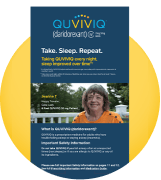
We might be gaining daylight, but patients are still losing sleep

Sleep Awareness Week and daylight savings are this month, making it even more important to have a conversation about sleep with your patients, and QUVIVIQ may help.1 QUVIVIQ is initiated differently, 50 mg every night,† so patients can be proactive about their sleep health.1 It is experienced differently leading to better sleep over time.1*

*Improvements measured at Months 1 and 3. †Recommended dosage of QUVIVIQ for patients with moderate hepatic impairment or those who are taking moderate CYP3A4 inhibitors is 25 mg no more than once per night.
Reference: 1. QUVIVIQ® (daridorexant) [prescribing information]. Radnor, PA: Idorsia Pharmaceuticals US Inc; 2024.

Quick access to all the
information you need

Enter query or select a filter by category to get your questions

Filter by category

What makes QUVIVIQ different?

In clinical trials, QUVIVIQ was assessed for its impact across the range of night & day insomnia symptoms.1,2

When taken every night, QUVIVIQ 50 mg continued to improve sleep over time* and reduced daytime sleepiness.
Daytime sleepiness was evaluated in a Study 1 secondary endpoint, and QUVIVIQ 50 mg led to statistically significant reduction in patient-reported IDSIQ sleepiness domain score (25 mg did not reach significance in either Study 1 or 2).1,2

QUVIVIQ has demonstrated safety with once-nightly dosing over 12 months of treatment, including in patients ≥65 years. Patients taking QUVIVIQ every night over 12 months reported no evidence of withdrawal symptoms upon discontinuation, no rebound insomnia, and adverse reaction rates comparable between doses and to placebo.2,3

QUVIVIQ works differently than other sleep medications that sedate the brain. QUVIVIQ is thought to block overactive wake signals, one of the underlying causes of insomnia, and has an 8-hour half-life.1,2

QUVIVIQ360 is a unique program that helps ensure your patients receive the medication you’ve prescribed.
Learn more about access and savings with QUVIVIQ360.

*Improvements measured at Months 1 and 3.

Night & Day Endpoints

What are the QUVIVIQ night and day efficacy endpoints?

Insomnia impacts both night and day, and QUVIVIQ clinical trials were designed to comprehensively assess the impact of QUVIVIQ across the range of insomnia symptoms through endpoints for night & day efficacy.1,2,4

NIGHTTIME

When taken every night, QUVIVIQ continued to improve sleep over time.* QUVIVIQ helps patients fall asleep faster, stay asleep longer, and gain more total sleep time. These sleep measures were assessed at Months 1 and 3 and showed statistically significant improvements compared with placebo.1 QUVIVIQ was also evaluated in a 40-week extension safety study, which included exploratory efficacy endpoints that showed QUVIVIQ maintained improvements in sleep over 12 months.1,3

DAYTIME

QUVIVIQ 50 mg reduced patient-reported daytime sleepiness as measured by the Insomnia Daytime Symptoms and Impacts Questionnaire (IDSIQ) secondary endpoint in Study 1. Patients reported how mentally tired, physically tired, energetic, and sleepy they were each day while taking QUVIVIQ. The 25 mg dose did not reach statistical significance compared with placebo in either Study 1 or Study 2.2,5

Review the nighttime and daytime data with once-nightly QUVIVIQ 50 mg.

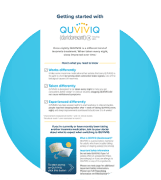
It’s important that both you and your patients know that QUVIVIQ works differently, is taken differently, and is experienced differently.

QUVIVIQ works differently and is thought to block overactive wake signals, unlike other medications that sedate the brain. QUVIVIQ also has an 8-hour half-life.1,2

QUVIVIQ is designed to be taken once every night. When taken nightly over 12 months in clinical trials, no evidence of withdrawal symptoms were reported upon discontinuation.2,3

Tell your patients that taking QUVIVIQ every night led to improved sleep over time.* In clinical trials, improvements with once-nightly QUVIVIQ were seen at Week 1 and continued to increase over 3 to 4 weeks.1†

Download a guide to help you set your patients up for success.

*Improvements measured at Months 1 and 3.

Based on subjective total sleep time data.

How does QUVIVIQ continue to improve sleep over time?

The efficacy of QUVIVIQ was evaluated at Months 1 and 3 when taken every night in the pivotal trials and showed that QUVIVIQ continued to improve sleep over time. Additionally, when QUVIVIQ was taken every night, patients saw improvements in sTST at Week 1 that continued to build over 3 to 4 weeks.1

Beyond the two 3-month pivotal studies, QUVIVIQ was also evaluated in a 40-week extension safety study, which included exploratory efficacy endpoints, for a total of 12 months of treatment duration. When taken nightly over 12 months in clinical trials, no evidence of withdrawal symptoms were reported upon discontinuation.2,3

See the efficacy data for once-nightly QUVIVIQ.

Does “reduced daytime sleepiness” refer to next-day somnolence?

No, QUVIVIQ was evaluated in clinical trials for its impact on the range of insomnia symptoms, which included both efficacy and safety outcomes related to daytime sleepiness. Rates of fatigue and next-day somnolence were reported as part of the QUVIVIQ safety profile.1

With QUVIVIQ, “daytime sleepiness” refers to the unique daytime efficacy outcome measured by the Insomnia Daytime Symptoms and Impacts Questionnaire (IDSIQ). In this patient-reported secondary efficacy endpoint, patients were asked to complete a daily self-assessment about how energetic, mentally and physically tired, and sleepy they felt during treatment. The change from baseline in these assessment scores (the IDSIQ sleepiness domain) was evaluated at Months 1 and 3.2,5

See the daytime outcomes data.

What is IDSIQ?

IDSIQ is the Insomnia Daytime Symptoms and Impacts Questionnaire, which is the first patient-reported outcome tool developed and validated according to FDA guidelines that can evaluate daytime symptoms in patients with insomnia.5

IDSIQ includes 14 items of daytime symptoms across 3 domains: sleepiness, mood, and alert/cognition.

Change from baseline in the IDSIQ sleepiness domain score at Month 1 and Month 3 was a key secondary endpoint in the QUVIVIQ clinical trials.2 See the IDSIQ results.

Safety

How long can my patients continue taking QUVIVIQ?

QUVIVIQ was designed to be taken every night, and, unlike other insomnia treatments, there is no recommended maximum duration of treatment. The efficacy and safety of QUVIVIQ was evaluated in two 3-month pivotal studies followed by a 40-week extension safety study. The extension study included exploratory efficacy endpoints that showed QUVIVIQ maintained improvements in sleep over 12 months.1-3

A total of 576 patients were treated with QUVIVIQ for at least 6 months and 331 patients for at least 12 months. Patients taking QUVIVIQ every night over 12 months reported no evidence of withdrawal symptoms or rebound insomnia upon discontinuation.1-3

See the demonstrated safety profile with once-nightly dosing.

What should my patients avoid while taking QUVIVIQ?

Patients should avoid alcohol consumption with QUVIVIQ. Concomitant use of alcohol or other CNS depressants with QUVIVIQ may lead to additive impairment of psychomotor performance and risk of CNS depression. Patients should be cautioned about the potential for next-morning driving impairment because there is individual variation in sensitivity to QUVIVIQ.1

Concomitant use with strong CYP3A4 inhibitors (eg, itraconazole, clarithroymycin) should also be avoided. With moderate CYP3A4 inhibitors (eg, diltiazem, fluconazole, grapefruit), the maximum recommended dose of QUVIVIQ is 25 mg. Concomitant use of QUVIVIQ with a strong or moderate inducer of CYP3A4 is not recommended.1,6

What happens if my patient stops taking QUVIVIQ?

In clinical trials and animal studies evaluating physical dependence, stopping administration of QUVIVIQ did not produce withdrawal signs or symptoms upon drug discontinuation. This suggests that QUVIVIQ does not produce physical dependence.1

Are there contraindications for QUVIVIQ?

QUVIVIQ is contraindicated in patients with narcolepsy and in patients with a history of hypersensitivity to QUVIVIQ.1

Are there dependence or addiction issues with QUVIVIQ?

Clinical studies have demonstrated no evidence of physical dependence, withdrawal symptoms upon discontinuation, or rebound insomnia. QUVIVIQ contains daridorexant, which is a Schedule IV controlled substance.1-3

Clinical studies of chronic administration suggest QUVIVIQ does not produce physical dependence. In controlled efficacy and safety studies, withdrawal effects were assessed by the Tyrer Benzodiazepine Withdrawal Symptom Questionnaire following discontinuation of 10 mg, 25 mg, and 50 mg QUVIVIQ, and by adverse event reporting during a single-blind placebo run-out period.1

Are there any drug-drug interactions?

Avoid concomitant use with strong CYP3A4 inhibitors (eg, itraconazole, clarithromycin) and strong CYP3A4 inducers (eg, rifampin, carbamazepine, phenytoin). With moderate CYP3A4 inhibitors (eg, diltiazem, fluconazole), the maximum recommended dose of QUVIVIQ is 25 mg.1,6

Co-administration of a single 50 mg dose of QUVIVIQ with alcohol at a blood level of 0.6 g/L led to additive effects on impairment of psychomotor performance (postural stability and alertness). QUVIVIQ did not affect alcohol concentrations and alcohol did not affect QUVIVIQ concentrations.1

Should my patients expect certain side effects?

Adverse reactions with QUVIVIQ were comparable between doses and to placebo. They include headache (≤7% with QUVIVIQ vs 5% with placebo), next-day somnolence or fatigue (≤6% with QUVIVIQ vs 4% for placebo), and dizziness and nausea (≤3% with QUVIVIQ vs 2% for placebo, respectively).1

QUVIVIQ can impair daytime wakefulness even when used as prescribed. Effects may persist in some patients for several days after discontinuing QUVIVIQ.

See additional safety profile information and full Important Safety Information for QUVIVIQ.

Can QUVIVIQ be used in elderly patients?

QUVIVIQ is indicated for the treatment of insomnia in adult patients ≥18 years of age, and clinical trials included adults ≥65 years old. When QUVIVIQ was taken every night, patients, including those ≥65 years, saw improvements at Week 1 that continued to build over 3 to 4 weeks.1*

Most common adverse reactions for all patients included headache, next-day somnolence or fatigue, and dizziness/nausea. In adults ≥65 years (50 mg, n=119; 25 mg, n=121; placebo, n=122)1,7:

  • Rates of next-day somnolence were 5% for 25 mg, 0.8% for 50 mg, and 0.8% for placebo
  • Rates of fatigue were 3.3% for 25 mg, 2.5% for 50 mg, and 0.8% for placebo

Additionally, fall rates were evaluated in the pivotal trials. Rates of falls with QUVIVIQ were <1% in Study 1 vs 3% with placebo, and rates in Study 2 were balanced across treatment groups (1%). QUVIVIQ can increase somnolence and drowsiness so patients, particularly the elderly, are at higher risk of falls.1,2

See the full safety profile.

*Based on subjective total sleep time data.

Once-Nightly Dosing

Why should QUVIVIQ be taken every night?

It’s important that both you and your patients know that QUVIVIQ works differently, is taken differently, and is experienced differently.

QUVIVIQ works differently and is thought to block overactive wake signals, unlike other medications that sedate the brain. QUVIVIQ also has an 8-hour half-life.1,2

QUVIVIQ is designed to be taken once every night. When taken nightly over 12 months in clinical trials, no evidence of withdrawal symptoms were reported upon discontinuation.2,3

Tell your patients that taking QUVIVIQ every night led to improved sleep over time.* In clinical trials, improvements with once-nightly QUVIVIQ were seen at Week 1 and continued to build over 3 to 4 weeks.1†

Download a guide to help you set your patients up for success.

*Improvements measured at Months 1 and 3.

Based on subjective total sleep time data.

Why would I start my patient on QUVIVIQ 50 mg?

The recommended dose of QUVIVIQ is 25 mg or 50 mg. The greatest improvement in sleep was seen with once-nightly QUVIVIQ 50 mg compared with placebo, and QUVIVIQ 50 mg reduced daytime sleepiness.1,2

When taken every night, QUVIVIQ 50 mg improved sleep over time and patients felt less tired the next day.* Patients, including those ≥65 years, saw improvements with once-nightly QUVIVIQ at Week 1 that continued to increase over 3 to 4 weeks.1,2†

Patients treated with QUVIVIQ 50 mg also saw statistically significant reductions in patient-reported daytime sleepiness in Study 1, as assessed by IDSIQ (secondary endpoint). The reductions in daytime sleepiness with QUVIVIQ 25 mg were not statistically significant in either Study 1 or Study 2.2

The adverse reactions with QUVIVIQ were comparable between doses and to placebo, including headache (≤7% with QUVIVIQ vs 5% with placebo), next-day somnolence or fatigue (≤6% with QUVIVIQ vs 4% for placebo), and dizziness and nausea (≤3% with QUVIVIQ vs 2% with placebo, respectively). Rates of falls with QUVIVIQ were less than 1% in Study 1 vs 3% with placebo, and rates in Study 2 were balanced across treatment groups (1%).1,2

When taken nightly over 12 months of treatment, patients reported no evidence of withdrawal symptoms upon discontinuation.2,3

Explore the nighttime and daytime efficacy data for QUVIVIQ 50 mg.

*Improvements measured at Months 1 and 3.

Based on subjective total sleep time data.

What is the starting dose of QUVIVIQ?

The recommended dose of QUVIVIQ is 25 mg or 50 mg, and QUVIVIQ was designed to be taken once every night. For patients with moderate hepatic impairment or taking a moderate CYP3A4 inhibitor, 25 mg is recommended. Avoid use with strong CYP3A4 inhibitors or strong CYP3A4 inducers and in patients with severe hepatic impairment. QUVIVIQ is contraindicated in patients with narcolepsy and in patients with a history of hypersensitivity to QUVIVIQ.1

QUVIVIQ was designed to be taken once every night. In clinical trials, greatest efficacy was seen with QUVIVIQ 50 mg compared with placebo, although both doses showed statistically significant improvements compared with placebo.

See full dosing and administration information.

How should my patients take QUVIVIQ?

Advise patients that QUVIVIQ was designed to be taken once every night within 30 minutes before bed and at least 7 hours before they plan to wake up. Time to sleep onset may be delayed if taken with or soon after a meal.1

When transitioning your patient from another insomnia medication to QUVIVIQ, be sure to consider any discontinuation symptoms of the prior medication such as withdrawal or risk for rebound insomnia. Tell your patients not to discontinue QUVIVIQ or increase their dose on their own, and to inform you if they believe QUVIVIQ isn’t providing the efficacy they need.

See full dosing and administration information.

What is the exact target or MOA of QUVIVIQ?

QUVIVIQ works differently than other sleep medications that sedate the brain. QUVIVIQ is thought to block overactive wake signals, one of the underlying causes of insomnia. QUVIVIQ reaches peak plasma concentration levels within 1–2 hours and has an 8-hour half-life.1,2

The orexin neuropeptide signaling system plays a role in wakefulness. Blocking the binding of wake-promoting neuropeptides orexin A and orexin B to receptors OX1R and OX2R is thought to suppress wake drive.1

What do I tell my patients about what to expect with QUVIVIQ?

QUVIVIQ may be different than other insomnia treatments your patients have taken in the past, so it’s important to talk to them about what to expect from treatment.

Tell your patients that QUVIVIQ works differently, is taken differently, and is experienced differently.

Download this guide for more details on what your patients need to know.

Access, Savings & Support

How can my patients get support while on QUVIVIQ?

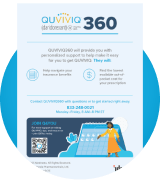
QUVIVIQ360 is the simple way to choose QUVIVIQ first for your adult patients with insomnia. Your patients can receive their first 30-day supply of once-nightly QUVIVIQ for $0* and subsequent monthly refills for as little as $25. Patients can receive their first fill while benefits are being investigated. Learn more about QUVIVIQ360.

Through QUVIVIQ360, your patients will also get support and ongoing education through Q&You. Visit QUVIVIQ.com/support to explore the program.

*Eligibility restrictions apply.

For eligible commercially insured patients. Terms and conditions apply. Please read the full terms and conditions. If your patients cannot afford QUVIVIQ, call 833-248-0021 to see how QUVIVIQ360 may be able to help.

What is QUVIVIQ360?

QUVIVIQ360 is a comprehensive program designed to help patients with insurance coverage support, affordability assistance, and ongoing education.

Learn more.

How can QUVIVIQ360 help my patients save on QUVIVIQ?

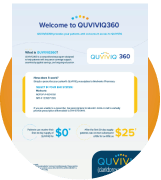
When you prescribe through QUVIVIQ360, patients can receive their first 30-day supply of nightly QUVIVIQ for $0.* After the first 30-day supply, patients can receive subsequent refills for as little as $25. If you prescribe through another pharmacy, you can provide your patients with a QSavings Copay Card, which they can bring with them when they pick up their first prescription. If your patient cannot afford QUVIVIQ, QUVIVIQ360 may be able to help.

*Eligibility restrictions apply.

For eligible commercially insured patients. Terms and conditions apply. Please read the full terms and conditions. If your patients cannot afford QUVIVIQ, call 833-248-0021 to see how QUVIVIQ360 may be able to help.

How can I prescribe through QUVIVIQ360?

Simply e-prescribe your patient’s QUVIVIQ prescription to Medvantx Pharmacy:

Select in your EHR system: Medvantx Pharmacy, NCPDP #4354180, NPI #1235371535.

If you are unable to e-prescribe, fax prescriptions to 844-907-3493 or call to verbally provide prescription information to 844-876-8444.

Explore these downloadable resources to help you and your patients get started with once-nightly QUVIVIQ.

QUVIVIQ Patient Brochure

Use this guide to help answer your patients’ questions about QUVIVIQ.

Download

Patient Expectations Checklist

Set your patients up for treatment success with these important reminders.

Download

Patient Guide to QUVIVIQ360

What your patients need to know about
getting their QUVIVIQ prescription through QUVIVIQ360.

Download

HCP Guide to QUVIVIQ360

An overview of the QUVIVIQ360 program, including patient savings details and how to prescribe through Medvantx Pharmacy.

Download

QSavings Copay Card

Your patients can save on QUVIVIQ at retail pharmacies with this universal copay card.

Download

State-Specific Pricing Disclosures

Colorado

Download

Connecticut

Download

Vermont Long-Form

Download

Vermont Short-Form

Download

QUVIVIQ Denials and Appeals Resource

Download

INDICATION

QUVIVIQ® (daridorexant) is indicated for the treatment of adult patients with insomnia characterized by difficulties with sleep onset and/or sleep maintenance.

IMPORTANT SAFETY INFORMATION

Contraindications

QUVIVIQ is contraindicated:

  • in patients with narcolepsy.
  • in patients with a history of hypersensitivity to daridorexant or any components of QUVIVIQ.

Warnings and Precautions

Central Nervous System (CNS) Depressant Effects and Daytime Impairment

QUVIVIQ can impair daytime wakefulness. CNS depressant effects may persist in some patients up to several days after discontinuing QUVIVIQ. Advise patients about the potential for next-day somnolence.

Driving ability was impaired in some subjects taking QUVIVIQ 50 mg. Risk of daytime impairment is increased if QUVIVIQ is taken with less than a full night of sleep or at a higher than recommended dose. If taken in these circumstances, caution patients against driving or other activities requiring complete mental alertness.

Use with other CNS depressants increases the risk of CNS depression, which can cause daytime impairment. Dosage adjustments of QUVIVIQ and CNS depressants may be necessary when administered together. Use with other insomnia drugs is not recommended. Advise patients not to consume alcohol in combination with QUVIVIQ.

Worsening of Depression/Suicidal Ideation

Patients with psychiatric disorders including insomnia are at increased risk of suicide. In primarily depressed patients treated with hypnotics, worsening of depression, suicidal thoughts and actions (including completed suicides) have been reported. Administer with caution in patients exhibiting symptoms of depression. Monitoring suicide risk and protective measures may be required.

Sleep Paralysis, Hypnagogic/Hypnopompic Hallucinations, and Cataplexy-Like Symptoms

Sleep paralysis, an inability to move or speak for up to several minutes during sleep-wake transitions, and hypnagogic/hypnopompic hallucinations, including vivid and disturbing perceptions, can occur with QUVIVIQ. Explain these events to patients.

Symptoms similar to mild cataplexy have been reported with orexin receptor antagonists and can include periods of leg weakness lasting from seconds to a few minutes, can occur at night or during the day, and may not be associated with a triggering event (e.g., laughter or surprise).

Complex Sleep Behaviors

Complex sleep behaviors, including sleepwalking, sleep-driving, and engaging in activities while not fully awake (e.g., preparing and eating food, making phone calls, having sex), have been reported to occur with the use of hypnotics, including orexin receptor antagonists, such as QUVIVIQ. These events can occur in hypnotic-naïve as well as in hypnotic-experienced persons. Patients usually do not remember these events. Complex sleep behaviors may occur following the first or any subsequent use of hypnotics, with or without the concomitant use of alcohol and other CNS depressants. Discontinue QUVIVIQ immediately if a patient experiences a complex sleep behavior.

Patients with Compromised Respiratory Function

QUVIVIQ has been studied in mild to severe OSA not using CPAP, and in patients with moderate COPD. The effects of QUVIVIQ on respiratory function should be considered if prescribed to patients with compromised respiratory function. QUVIVIQ has not been studied in patients with mild or severe COPD.

Need to Evaluate for Comorbid Diagnoses

Treatment of insomnia should be initiated only after careful evaluation of the patient. Re-evaluate for comorbid conditions if insomnia fails to remit after 7 to 10 days of treatment. Worsening insomnia or new cognitive or behavioral abnormalities may be the result of an underlying psychiatric or medical disorder and can emerge during treatment with sleep-promoting drugs such as QUVIVIQ.

Most Common Adverse Reactions

The most common adverse reactions (reported in ≥ 5% of patients treated with QUVIVIQ and at an incidence ≥ placebo) were headache and somnolence or fatigue.

Drug Interactions

  • CYP3A4 Inhibitors: The recommended dose of QUVIVIQ is 25 mg when used with a moderate CYP3A4 inhibitor. Concomitant use of QUVIVIQ with a strong inhibitor of CYP3A4 is not recommended.
  • CYP3A4 Inducers: Concomitant use of QUVIVIQ with a strong or moderate inducer of CYP3A4 is not recommended.

Use in Specific Populations

Pregnancy and Lactation

There are no available data on QUVIVIQ use in pregnant women to evaluate for drug-associated risks of major birth defects, miscarriage, or other adverse maternal or fetal outcomes. There will be a pregnancy exposure registry that monitors pregnancy outcomes in women exposed to QUVIVIQ during pregnancy. Pregnant women exposed to QUVIVIQ and healthcare providers are encouraged to call Idorsia Pharmaceuticals at 1-833-400-9611.

Daridorexant is present in human breast milk in low amounts. There are no data on the effects of daridorexant on the breastfed infant or its effects on milk production. Infants exposed to QUVIVIQ through breastmilk should be monitored for excessive sedation.

Geriatric Use

Because QUVIVIQ can increase somnolence and drowsiness, patients, particularly the elderly, are at higher risk of falls. No dosage adjustment is required in patients over the age of 65 years.

Hepatic Impairment

QUVIVIQ is not recommended in patients with severe hepatic impairment. Reduce the dose in patients with moderate hepatic impairment.

Drug Abuse and Dependence

  • QUVIVIQ is a Schedule IV controlled substance.
  • Because individuals with a history of abuse or addiction to alcohol or other drugs may be at increased risk for abuse and addiction to QUVIVIQ, follow such patients carefully.


Please see full Prescribing Information.

References:

1. QUVIVIQ® (daridorexant) [prescribing information]. Radnor, PA: Idorsia Pharmaceuticals US Inc; 2024. 2.

2. Mignot E, Mayleben D, Fietze I, et al. Safety and efficacy of daridorexant in patients with insomnia disorder: results from two multicentre, randomised, double-blind, placebo-controlled, phase 3 trials. Lancet Neurol. 2022;21:125-139.

3. Kunz D, Dauvilliers Y, Benes H, et al. Long-term safety and tolerability of daridorexant in patients with insomnia disorder. CNS Drugs. 2022; https://doi.org/10.1007/s40263-022-00980-8.

4. Diagnostic and Statistical Manual of Mental Disorders. 5th ed. American Psychiatric Association; 2013.

5. Hudgens S, Phillips-Beyer A, Newton L, et al. Development and validation of the Insomnia Daytime Symptoms and Impacts Questionnaire (IDSIQ). Patient. 2021;14:249-268.

6. Table of Substrates, Inhibitors and Inducers. Food and Drug Administration. Accessed January 5, 2023. https://www.fda.gov/drugs/drug-interactions-labeling/drug-development-and-drug-interactions-table-substrates-inhibitors-and-inducers.

7. Fietze I, Bassetti CLA, Mayleben DW, et al. Efficacy and safety of daridorexant in older and younger adults with insomnia disorder: a secondary analysis of a randomised placebo-controlled trial. Drugs Aging. 2022;39:795-810.